2026 Terra Nova Raptor Nest Monitoring Project Description
Peregrine Falcons commonly nest at Terra Nova between March and June each year. Southwest Oregon Climber’s Coalition (SWOCC) will be monitoring territorial response during the 2026 nesting season. Based on these observations, SWOCC will provide recommendations to climbers for maximizing access while minimizing negative impacts to local wildlife.
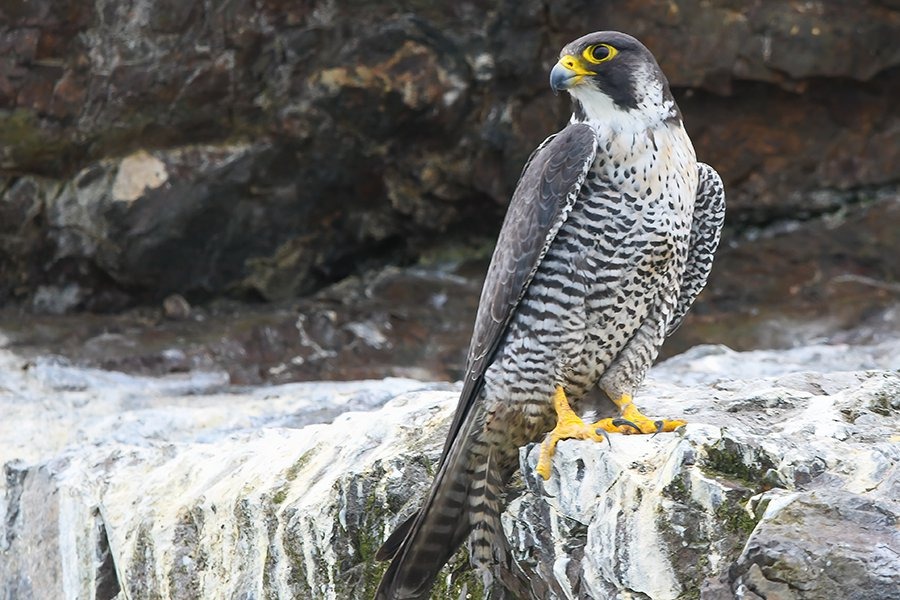
Photo source: Robin Edwards
Background: Peregrines have been nesting at Terra Nova long before climbers were in the area. They need tall cliffs with large ledges or cavities to lay eggs and feed their young until they are old enough to leave the nest (called “fledging”). Both parents take care of the young and will defend the nest by making loud repetitive sounds (called “cacking”), flying in circles, or diving towards perceived threats (including humans and pets). Peregrines are most reactive to human activities that they can see and are close to their nest.
The timing and location of nesting is somewhat predictable. Organized nest monitoring can be used to confirm the birds’ activity and predict which human activities and locations may be most disruptive to their nesting success. As stewards of this crag we aim to minimize our impacts on these birds, which is easy to do once we all know what to look for.
Monitoring Plan: SWOCC is monitoring the peregrines this year to determine where they are nesting, how long they are likely to occupy the nest, and which areas climbers are most likely to disrupt the birds. Monitoring will involve observing the peregrines and their behavior across all periods of their nesting activity from March through June (see table below for more detail). Based on these observations, recommendations will be provided to climbers and updated continuously as more information becomes available.
How Climbers Can Help:
- Check Mountain Project for the most up to date closure recommendations before climbing.
- Pay attention to raptor activity at the crag. If a raptor seems agitated, stop what you are doing or relocate to an area away from the bird.
- Have one member of your party fill out the Climber Survey Form whenever you climb at Terra Nova during our monitoring period.
Table 1: predicted timing of raptor nesting activity at Terra Nova and corresponding monitoring plans.
| Mar 1 – Mar 31 | Apr 1 – Apr 10 | Apr 11 – Apr 30 | May 1 – May 10 | May 11 – Jun 16 | Jun 17 – Jul 1 | |
| Raptor Activity | Courtship and Nest Selection | Egg Laying | Incubation | Hatching | Chick Rearing | Fledging |
| SWOCC Monitoring Actions | Monitor crag for bird sensitivity. Communicate recommendations to climbers | Identify nest location. Monitor for sensitivity. Communicate updates to climbers | Estimate fledge date. Monitor for sensitivity. Communicate updates and end of closure dates to climbers | Confirm fledge. | ||
| Recommended Climber Actions | Do not climb routes near nest ledges. Pay attention to raptor responses | Respect closures of nest location and sensitive areas within crag. Check for closure updates. | ||||
| Fill out and submit the Climber Survey Form. | ||||||
Have questions? Contact Nora Honkomp at nora@honkomp.net
Great Resources for Further Reading:
Learn what a Peregrine Falcon looks and sounds like – https://www.allaboutbirds.org/guide/Peregrine_Falcon/
The Access Fund’s Raptor Management Guide – https://d1w9vyym276tvm.cloudfront.net/assets/2132_AF-Raptor-Paper-150dpi_v3a.pdf?mtime=20210617140457&focal=none
History of Peregrine Falcons in North America – https://peregrinefund.org/history-peregrine-falcon
USFWS information about bird nests – https://www.fws.gov/story/bird-nests
Thanks for being a great steward of this crag! You rock 🙂